
When a leak or storm damages a commercial or residential roof, the first 72 hours determine loss severity and insurance outcomes; this guide gives facility managers a clear, prioritized playbook for roof repair gulfport ms incidents. You will get an immediate safety checklist, step-by-step containment and documentation templates, a rapid contractor-vetting checklist for local roofing services Gulfport, and practical criteria for temporary fixes, coatings, or replacement that hold up in Gulf Coast conditions.
1. Immediate safety triage and scene control (first 0 to 2 hours)
Start by protecting people and critical systems. Human safety and energized equipment are the only priorities that outrank preserving the roof itself during the first two hours after a leak or storm. Shut down circuits that serve wet areas, cordon off slick floors, and move staff and tenants away from rooms with active dripping or ceiling collapse risk.
Assign an incident lead and record time-stamped actions. Put one facilities person in charge, log the name, time, and every directive in a incident log. That log is the spine of any later insurance claim or contractor handoff and keeps responders from working at cross-purposes.
On-scene quick checklist
- Immediate hazards: Evacuate areas near dangling ceilings or saturated electrical panels and call 911 if structural collapse or exposed live wiring is present.
- Power control: Have your facilities electrician open breakers feeding the wet zone; label circuits affected and log the action.
- Interior triage: Move critical assets (servers, medicinals, inventory) to dry zones, deploy plastic sheeting and water-collection buckets, and start containment pumps if available.
- Rooftop access: Do not permit rooftop access to staff. Only a licensed crew should go on a wet or wind-damaged roof.
- Contractor contact: Place a call to a 24/7 emergency roofer such as the local team on the Roof Waterproofing Company emergency page: Emergency roof repair.
Trade-off to accept: quick interior exposure vs uncontrolled failure. Cutting a small ceiling relief hole relieves pooled water weight and can prevent a full collapse, but it creates a larger visible damage patch that must be documented. In practice the right choice is the one that protects occupants and mission-critical equipment, even when it complicates later cosmetic repairs.
Limitation to expect: temporary fixes are constrained by weather and safety. Emergency tarping and exterior containment may be impossible in sustained high winds; insist your contractor documents refused access or unsafe conditions so insurers do not deny a claim for lack of attempted containment.
Concrete example: A municipal office in Gulfport took two decisive steps after a night storm: facilities shut power to a flooded telecom closet, moved core switches to an upstairs rack within 30 minutes, and placed buckets and plastic. A prequalified roofer arrived within eight hours to tarp the roof and provided dated photos and an itemized temporary-repair invoice that the claims adjuster accepted the next day.
incident log, and call a licensed, insured emergency roofer immediately to avoid ad hoc fixes that can complicate reimbursement.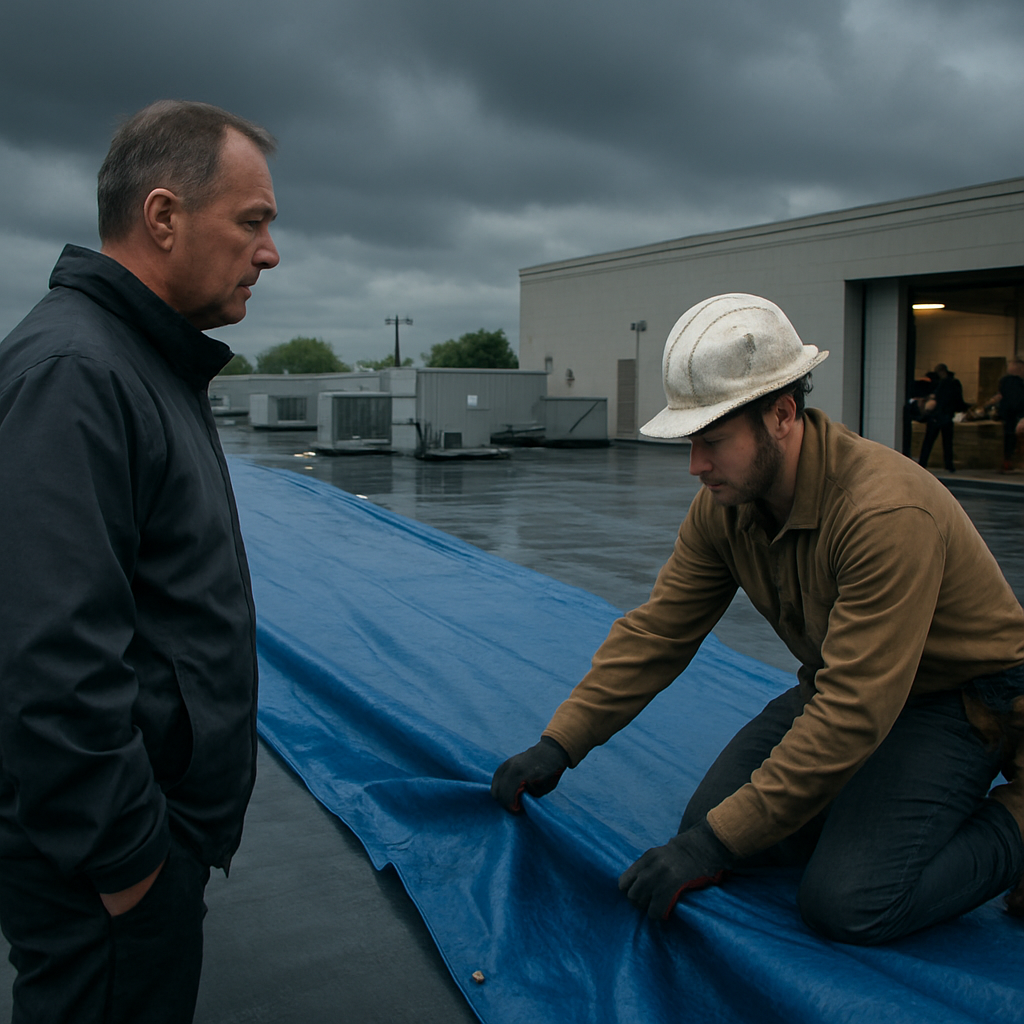
2. Containment and temporary measures to stop further water intrusion (0 to 24 hours)
Containment in the first day prevents most of the real cost: interior asset loss, mold, and equipment downtime. Prioritize stopping water where it enters, then control flow inside the building. Temporary measures are not cosmetic; they are structural triage intended to hold until a licensed contractor can evaluate permanent repairs.
Practical exterior containment steps that work in Gulfport conditions
Do not improvise with office supplies. Use commercial-grade materials and methods that survive wind and salt air. The wood-batten method with stainless fasteners and UV-resistant poly tarps is the standard for low-slope commercial roofs because it resists uplift far better than adhesive or nail-only fixes.
- Inspect anchor points: Identify stable tie-offs such as parapet coping, roof curbs, or saddle points. Avoid attaching to loose flashing or rusted metal which will fail under wind.
- Select the right tarp and hardware: Use heavy-duty polyethylene tarps rated for commercial use (12 mil or higher), 2×4 wood battens, 1/4 inch stainless screws with neoprene washers, and marine-grade rope for edge ties.
- Install with containment in mind: Lay the tarp over the damage, fasten battens across the tarp with screws through the batten into solid substrate (not through loose flashing), and create a small diverter so water sheds to the nearest functioning drain rather than pooling under the tarp.
- Protect rooftop penetrations: Temporarily collar vents and HVAC curbs with butyl or non-curing mastic rather than permanent sealants; these materials are removable and reduce the chance of trapped moisture.
- Time-limit and schedule removal: Record an agreed removal date (typically 72 hours) and require the emergency crew to return with a written path to permanent repair; long-term tarping hides damage and raises insurance friction.
Trade-off to accept: a professionally installed tarp will cost more than a quick handyman patch but it reduces secondary damage and claim disputes. In practice, cheap adhesive patches or staples create new failure points and often force larger repairs later.
Limitation worth noting: tarping can be unsafe or ineffective in sustained high winds. If conditions prevent safe exterior work, document the reason, take comprehensive photos from a safe distance, and focus on interior containment until crews can access the roof safely.
Concrete Example: A Gulfport strip mall with a TPO low-slope roof experienced seam separation after a storm. The facility manager engaged a licensed emergency crew who installed 20×30 commercial tarps with 2×4 battens and stainless screws, routed diverted water to a working scupper, and provided time-stamped photos and an itemized temporary repair invoice. That documentation shortened the insurer site visit and cleared the way for a scheduled seam-repair and coating within two weeks.
Key operational rule: require every temporary repair to come with a dated photo set, the installer license number, and a written statement that the work is temporary and what permanent scope is needed.
Final judgment: treat temporary containment as a purchased risk control, not a DIY stopgap. Spending a little more up front for documented, code-aware containment reduces downtime, simplifies claims, and prevents small leaks from turning into full replacements.
3. Documenting damage for insurance and regulatory purposes (0 to 72 hours)
Direct point: Insurers and building inspectors will treat your early documentation as evidence of cause, timing, and mitigation. High quality, time-stamped records materially improve claim outcomes for roof repair gulfport ms and speed regulatory clearances.
What wins claims: clear context photos, close-up defect detail, contractor identity and timestamps, and a concise incident narrative that ties actions to observed damage. Poorly organized photos or unsigned temporary repair receipts create unnecessary friction and delays.
Photographing and logging – what to capture and why
| Shot type | Framing and why it matters |
|---|---|
| Wide context | Show the damaged roof field relative to edges, drains, and adjacent units so adjusters know the exact area of loss |
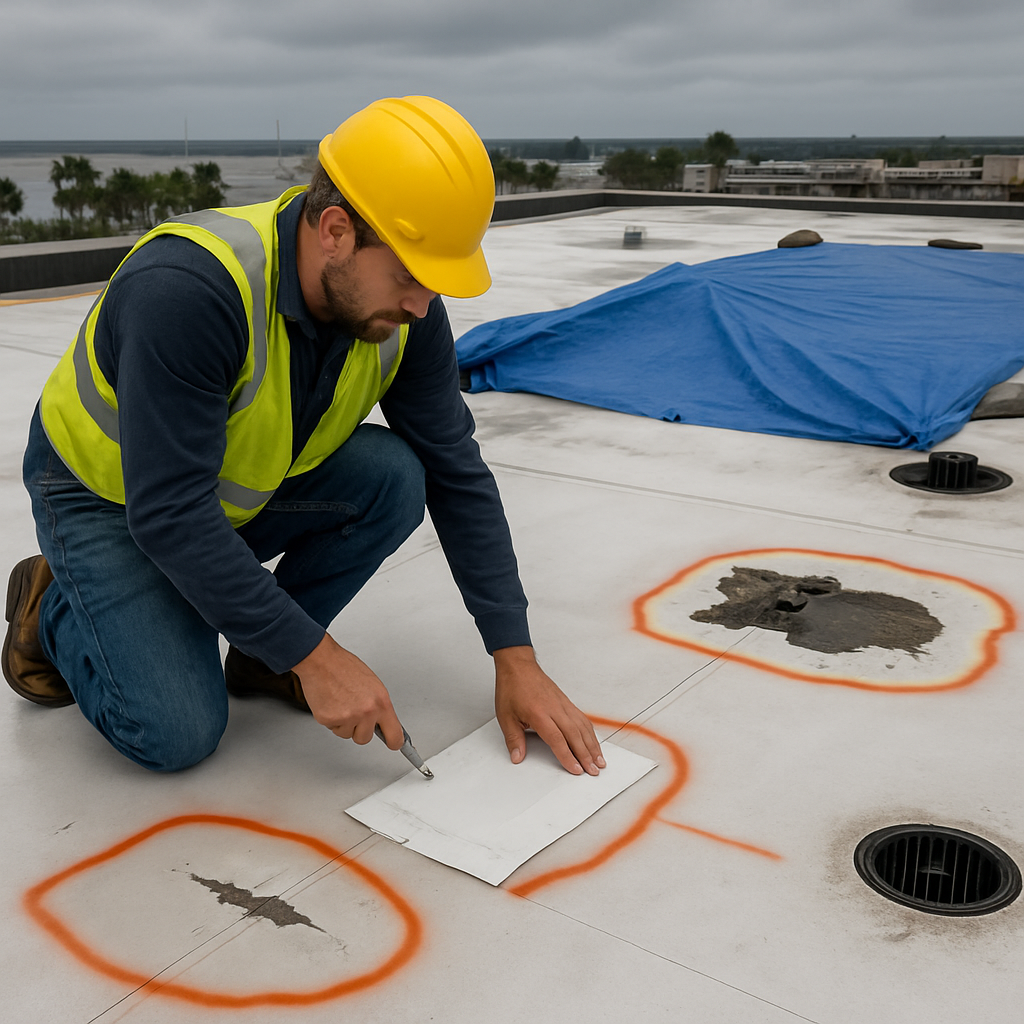
| Close-up detail | Tight shots of seam failures, punctures, torn flashing, missing fasteners, and rusted metal to document mechanism of failure |
| Interior effect | Ceiling stains, ruined ceiling tiles, saturated electrical panels, and equipment with a ruler or known object for scale |
| Temporary work | Photos of tarps, battens, and temporary collars with installer badge or license plate visible to prove timely mitigation |
| Measurement readouts | Moisture meter or ladder height photos that show quantitative data and access limitations for inspectors |
- Immediate packet: Assemble time-stamped photos, your incident log entry with names and times, and the temporary repair invoice from the emergency crew.
- Attach contractor credentials: Scan or photograph the emergency roofer license, proof of insurance, and the written two-part proposal that separates temporary tarping from permanent scope.
- Preserve originals: Upload everything to cloud storage and mark one copy as official for the insurance adjuster and one copy for facilities records.
Practical limitation: When rooftop access is unsafe you will not get the ideal close-up shots. In that case capture detailed aerial context from a safe ground vantage or use a licensed contractor to provide GPS-tagged photos and a signed access statement. Insurers accept documented safety refusals far more readily than missing evidence.
Concrete example: A Gulfport office experienced multiple ponding leaks after a storm. Facilities logged times, photographed standing water next to HVAC curbs, and had a licensed crew from the local emergency roster install documented tarps within 12 hours. The adjuster approved temporary repairs the same week because every photo included a dated installer invoice and license plate of the service truck.
Judgment: Quality beats quantity. A smaller set of clear, time-stamped, signed items will out-perform hundreds of ambiguous photos. Organize evidence so an adjuster or inspector can reconstruct the event in under five minutes.
Next consideration: Use this documented packet to request an expedited adjuster visit and to open any required permits with the City of Gulfport – early regulator engagement prevents rework and speeds final approvals for permanent roof repair gulfport ms.
4. Rapid roof damage assessment and prioritization by roof type (24 to 72 hours)
Start with roof-system triage, not guesswork. Different systems fail in predictable ways—address the mechanism, not just the leak. Prioritize roofs that threaten life-safety, electrical and mission-critical spaces, then work outward to less-critical areas.
A practical triage framework by roof system
| Roof type | Typical short-term risk (24-72h) | Priority action | What to expect for permanent scope |
|---|---|---|---|
| Low-slope single-ply (TPO/EPDM) | Seam failure, large ponding, quick vapor-driven leaks | Immediate tarping at ponding zones and clear drains; targeted seam patches on accessible areas | Seam repairs + recoat if substrate sound; replacement if membrane delaminated or insulation saturated |
| Built-up / modified bitumen | Blistering, gravel wash-off, flashing loss | Remove loose aggregate around leaks, temporary flashing collars, isolate problem roof drains | Localized relayering possible; widespread saturation requires replacement |
| Metal panel / standing seam | Fastener pull-out, panel tears, corrosion at penetrations | Secure loose panels, temporary seam clamps or sheet patches, protect exposed insulation | Panel replacement and fastener upgrade; consider corrosion mitigation coatings |
| Asphalt shingle / steep slope | Shingle blow-off, underlayment exposure, valley failure | Short-term cover with breathable underlayment or adhesive patches on hips/valleys | Patch for isolated loss; partial or full replacement for large-area wind damage |
| Tile / slate | Broken tiles, slipped battens, water entry at penetrations | Replace broken tiles over critical interiors, install temporary blankets beneath tiles if accessible | Re-battening and targeted replacement; structural checks if underlayment failed |
Trade-off to manage: speed versus longevity. A rapid prioritized patch that restores watertightness will save interiors and operations today but may create overlapping materials that complicate a future full replacement. Capture as-built photos and insist the contractor labels temporary work and intended follow-up scope to avoid invalidating warranties or creating hidden failure layers.
Operational nuance: low-slope roofs over critical spaces deserve higher urgency than larger-area cosmetic damage on a sloped roof. In Gulfport, low-slope failures frequently drive business interruption because ponding and seam failures propagate rapidly; treat those as highest priority for 24-72 hour action.
Concrete example: A Gulfport logistics warehouse with a TPO roof developed seam separation after a storm. Facilities prioritized the zone over the electrical room, had an emergency crew install a diversion tarp and clear the nearest drains within 36 hours, and documented membrane samples and moisture readings. That immediate prioritized action prevented transformer water damage and kept operations running while the insurer reviewed quotes for seam-repair and a partial recoat.
Judgment you need: do not let a single visible leak drive an entire replacement decision within 72 hours. Use the short window to stabilize, document, and classify: emergency containment, short-term watertight repairs, or full replacement. If the substrate is compromised, move quickly toward replacement; if the substrate is intact, a prioritized repair + coating path often preserves capital and reduces downtime. When in doubt, get a licensed, insured local roofer to provide a written assessment and GPS-tagged photos—insurers accept documented professional assessments far more readily than ad hoc opinions. See FEMA guidance for mitigation documentation standards.
5. How to vet and hire a roofing contractor quickly in Gulfport
You can hire a competent, insured roofer in Gulfport within 24 to 48 hours if you use a short, evidence-driven vetting framework. Treat the first contractor call as the start of a procurement record: capture names, vehicle details, promised ETA, and whether they commit to a written two-part scope that separates emergency containment from permanent repairs.
Rapid vetting checklist (use in your incident log)
- Verify legal standing: ask for current license number and contractor registration; confirm business address in Gulfport and check the City of Gulfport Building Department records when you can (City of Gulfport Building Department).
- Confirm insurance: require emailed certificates for General Liability and Workers Compensation before work begins; note policy effective dates and carrier phone number.
- Demand a two-part written proposal: a short emergency scope with ETA, materials for temporary work, removal timeline, and a separate permanent repair or replacement proposal with materials, warranty terms, and permit responsibility.
- Check coastal experience: request two recent Gulfport-area projects for waterproofing, coatings, or wind-damage repairs that demonstrate work on similar roof systems (TPO, metal, shingle, tile).
- Get local references fast: call one facilities manager reference and ask about response time, permit handling, and whether the contractor documented temporary measures with dated photos or GPS-tagged images.
- Lock down payment and lien terms: refuse blanket upfront payments; use milestone payments tied to documented completion stages and require a final lien waiver on full payment.
- Confirm inspection and permit plan: who files permits, who schedules final inspections, and what sign-off paperwork you will receive for the file.
Trade-off to accept: faster response often comes at a premium. Paying more for a documented emergency crew that provides a written handoff to a permanent team usually reduces total cost and downtime versus a cheapest-available patch that fails under Gulf Coast wind and salt exposure.
Practical limitation: some contractors will not commit to permits or long-term warranties for emergency tarping work. If the responder declines permit filing, require them to put that limitation in writing and plan a follow-up from a licensed crew who will close permits and provide warranty documentation for the permanent repair.
Concrete example: A Gulfport warehouse called three local roofers after a storm. One crew arrived in 10 hours, installed documented commercial tarps, emailed a two-part proposal that included permit handling, and provided contactable Gulfport references. The facility manager accepted the proposal; because the emergency work was written and auditable, the insurer released funds for permanent seam repairs within one week and the project moved straight to scheduled recoat work without dispute.
Key hiring judgement: prioritize documented capability over low price. A contractor who refuses to split temporary containment from permanent scope, or who will not provide proof of insurance and local references, creates more risk to claims and continuity than the short-term cost savings are worth.
6. Permanent repair options, coatings, and expected timelines
Key point: permanent repairs succeed or fail on substrate condition. A coating is only as good as the deck and insulation it covers; if insulation is saturated, fasteners are corroded, or the deck is delaminated, a coating will mask problems and accelerate failure.
Primary repair paths: there are four realistic outcomes after a professional assessment: targeted patching, seam and flashing replacement, recoat with a compatible coating system, or full tear-off and replacement. Choose by mechanism of failure, not by cost pressure.
- Targeted patching when damage is small and the membrane and insulation test dry – inexpensive and fast but only a short to mid-term fix.
- Seam and flashing repair for wind-lift failures – restores watertightness if the underlying membrane is intact and insulation is dry.
- Coating systems when the substrate is structurally sound – silicone tolerates ponding water, high-solids acrylics excel on well-draining, UV-exposed sloped roofs, and polyurethanes are an option where abrasion resistance is needed.
- Full replacement when insulation is saturated, there is deck rot, or damage is extensive – this is the only permanent fix that restores design life in many Gulf Coast failures.
Practical trade-off: coatings reduce capital outlay and downtime but require thorough surface prep and resolution of drainage issues. In practice, a coating applied over marginal substrate saves money in year one and produces a larger bill in years three to five if moisture or structural problems were missed.
Limitations and permit note: many coating applications and all replacements require local permit review in Gulfport. Plan for permit paperwork to add time to a replacement project and to be part of the insurer conversation. For product guidance, see the technical resources at the Roof Coatings Manufacturers Association.
Real-world example: A Gulfport medical clinic had multiple ponding locations after a hurricane. The on-site assessment found dry insulation but multiple seam failures. The facility elected for seam repairs and a silicone coating. Prep and seam work took 5 days, coating mobilization completed in a 2-day window of dry weather, and the system returned to service in 12 days with a 10-year limited coating warranty documented in the folder.
Expected timelines you can plan to commit to: assessment and moisture testing 24 to 72 hours after safe access; prioritized short repairs 3 to 10 days; coating jobs scheduled 1 to 4 weeks depending on weather windows and contractor backlog; full tear-off and replacement 2 to 10 weeks depending on scope, materials, and permit cycles. Commercial sites with multiple roof zones trend to the longer end because of staging and traffic control.
Judgment call that matters: do not accept a vendor who offers an immediate coating without quantitative moisture verification and a written statement that the roof is suitable for coating. In Gulfport salt-air conditions, corrosion or trapped moisture is the silent failure mode that voids warranties and causes rapid rework.
Important: coatings extend life when used as part of a documented rehab, not as a stopgap over hidden moisture or damaged deck. Verify and document substrate dryness and drainage correction before signing a final scope.
7. Post-repair resilience, maintenance plan, and closing the incident
Finish the paper trail before you finish payments. Finalizing a roof repair gulfport ms incident is administrative work that materially reduces future risk and avoids warranty disputes. Collect the contractor completion certificate with permit closure, manufacturer warranty documents, final as-built photos, and the invoice tied to a final lien waiver. Store one copy in your facilities management system and another in cloud storage linked to the insurance claim number and incident log.
Maintenance framework and responsibilities
- 0 to 30 days: Confirm permit sign-off, run a moisture baseline of repaired zones with a pin or noninvasive meter, and get the contractor to deliver an agreed punch list for minor cleanup items.
- 30 to 90 days: Schedule the first post-repair inspection with your facilities engineer and the original contractor to verify drains, scuppers, and flashing remain functional after settling and a couple of rain events.
- 6 months: Perform a hands-on inspection and clean roof drains, remove debris, and verify coating adhesion if a coating system was applied; document findings and photo-evidence in the roof asset file.
- Annual: Formal roof condition assessment tied to budget cycles; include a moisture scan, fastener checks for metal roofs, and resealing of penetration flashings as needed.
- 5-year planning: Review coating service life and plan either a recoating or targeted replacement depending on moisture trends and warranty windows.
Practical trade-off: Spending on preventive maintenance reduces unexpected downtime but increases OPEX. In Gulfport coastal conditions the balance usually favors more frequent drain maintenance and mid-life coating touch-ups because salt-air corrosion and UV exposure accelerate failure modes that are expensive to reverse.
Limitation to accept: Warranties are conditional. Many coating and workmanship warranties require documented maintenance actions and periodic inspections. If you skip scheduled checks the manufacturer or contractor can deny a claim later. Insist the warranty spell out required inspection cadence and retention of documentation.
Concrete example: After a hurricane, a Gulfport multi-tenant office completed seam repairs and a silicone coating. The facilities manager required a 30-day moisture scan and logged semiannual drain cleanings. Three years later a localized fastener corrosion issue was detected early and repaired under the contractor workmanship warranty, avoiding a larger partial replacement.
Do not close the incident file until you have signed permit closure, a final invoice with lien waiver, as-built photos, and a written maintenance schedule attached to the warranty.
Final consideration: schedule the first formal post-repair inspection within 30 days and attach its report to the insurance claim and the roof asset register so future adjusters and contractors see a continuous maintenance history.