
If you are responsible for a warehouse, office, retail center or municipal facility and are searching for commercial roof cleaning services near me, this guide gives a practical, step-by-step roadmap for hiring, inspecting and verifying local contractors. You will get the professional workflow: inspection, debris and drain clearing, low-pressure soft washing, ponding diagnosis and documentation for warranty compliance, plus a contractor checklist to confirm safety, coating compatibility and a clear scope of work. Expect ballpark costs, recommended cleaning frequencies and decision rules for when cleaning will protect the roof and when you need tapered insulation, added drains or full roof system repair.
Why professional commercial roof cleaning protects assets and coatings
Direct impact: organic debris, granule loss and algae are not cosmetic—they are active failure drivers. Leaves, pollen and roof dust trap moisture, feed microbial growth and abrade coating films. Over time that weakens reflectivity on white roofs, accelerates membrane embrittlement on TPO and PVC, and erodes aggregate on modified bitumen and metal flashings.
How cleaning preserves function and value
Asset protection is measurable: keeping drains clear and removing algae reduces the frequency of leaks and the rate of coating degradation. Professional cleaning preserves thermal performance of reflective coatings which lowers cooling load and keeps the roof within manufacturer maintenance requirements that many warranties require for valid claims. See manufacturer guidance for cleaning to support warranty preservation at Carlisle SynTec technical library.
- TPO and PVC: remove sediment and biofilm to prevent seam stress and membrane abrasion
- EPDM: clear debris that retains moisture against seams and flashings
- Modified bitumen: dislodge trapped grit that shortens coating adhesion life
- Metal roofs: remove biological staining and magnetic debris that cause rust initiation
Trade-off to accept: cleaning reduces many risks but it does not correct underlying slope or structural deflection. If ponding returns within weeks of a certified cleaning, that is a signal that physical remediation – tapered insulation, additional drains or structural work – is required. Spending repeatedly on cleaning without addressing ponding is poor lifecycle spending.
Practical constraint: not every local provider advertising commercial roof washing is coating-savvy. When you search for commercial roof cleaning services near me, require evidence of manufacturer-compatible methods, MSDS for chemicals, and before/after documentation. Contractors who default to high-pressure washing commonly damage coating reflectivity and void warranties.
Concrete example: A regional distribution center with a white TPO roof and heavy tree cover began to show localized ponding and algae streaks. A qualified crew cleared sediment from the roof and drains, performed a manufacturer-approved soft wash, and documented drains with video. The immediate result was restored drainage and a maintenance record that supported a later warranty claim for a failing seam repaired under the original coating warranty by the roofing contractor Roof Waterproofing Company.
Professional cleaning is preventive maintenance with consequences – it extends coating life and protects building assets only when done to manufacturer standards and paired with drain and ponding remediation when needed.
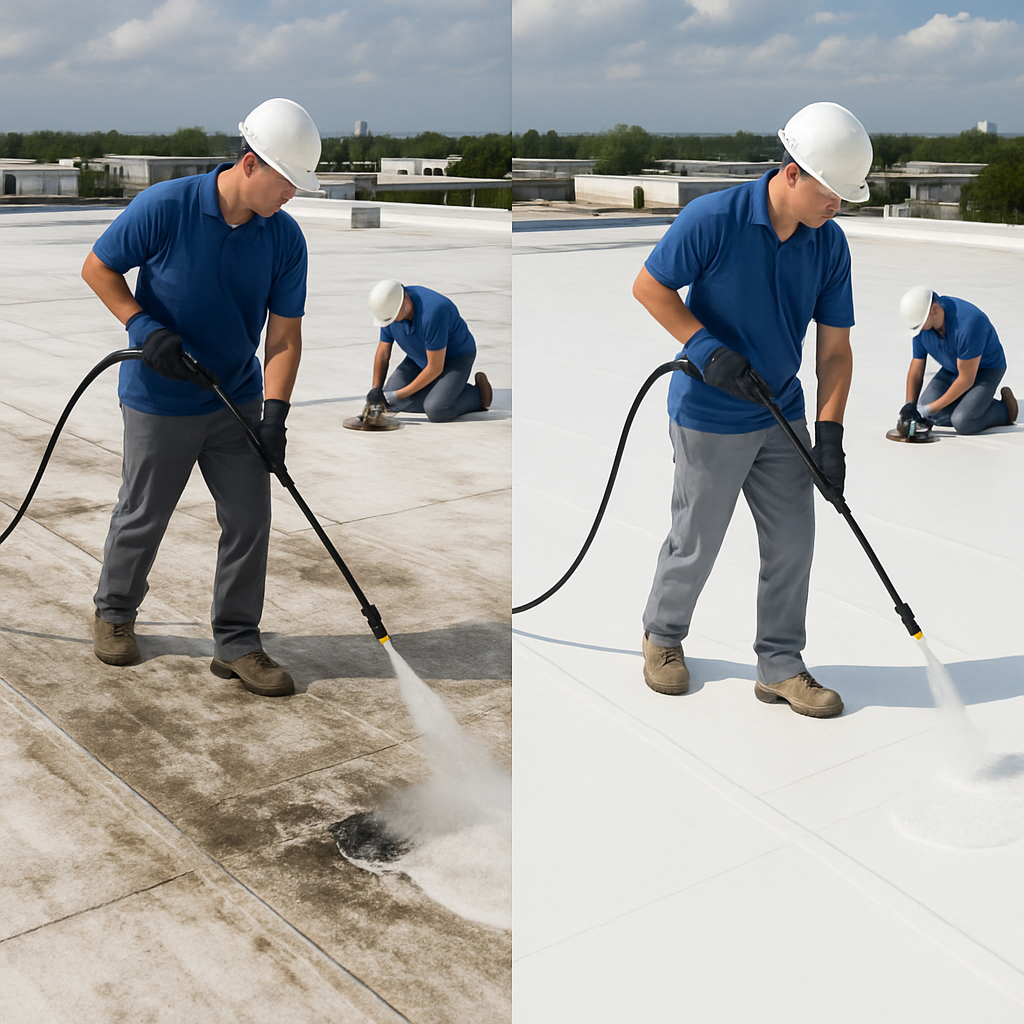
Next consideration: before approving work, confirm the contractor follows the NRCA roof maintenance guidance and local stormwater rules on wash water containment to avoid regulatory and warranty problems. See NRCA roof maintenance for standards to reference in the scope.
Comprehensive roof cleaning workflow used by professionals
Start with verification, not cleaning. A competent crew begins by confirming roof assembly, coating manufacturer, drain locations and known problem areas before any tool or chemical touches the surface.
Standard professional workflow
- Pre-clean survey: Walk the roof with photos and a drain map; note coating type, seam conditions and rooftop equipment that could block access or be contaminated by wash water.
- Containment plan: Establish wash-water capture and diversion to prevent discharge to storm drains and protect rooftop units; identify overflow routing and temporary barriers.
- Debris removal: Remove leaves, grit and large litter using low-impact mechanical tools and vacuums; sequence work so cleaned drains stay clean (work from high points toward drains).
- Drain and scupper service: Manually clear, rod or vacuum drains; where appropriate, run a camera downspout inspection and log results for the maintenance record.
- Soft wash cleaning: Apply manufacturer-approved detergent at specified dilution and dwell time, agitate only where safe, then low-pressure rinse. Avoid high-pressure cleaning on coated systems unless a coating maker explicitly allows it.
- Spot remediation and inspection: Inspect seams, flashings and penetrations; perform small repairs (re-seat flashings, reseal seams) that are part of the agreed scope.
- Documentation handoff: Deliver before/after photos, drain videos, chemical MSDS, a short condition report and recommended follow-up schedule tied to warranty requirements.
Practical trade-off: Running a full drain-camera inspection and capturing wash water adds cost and time, but skipping those steps often creates recurring trouble and can void warranty claims. Budgeting up front for proper containment and documentation prevents larger repair costs later.
Limitations to accept: This workflow removes immediate contamination and unclogs drainage, but it does not correct persistent slope deficiencies or structural deflection. When ponding reappears after a verified cleaning, plan for tapered insulation or additional drains rather than repeating cleaning.
Concrete example: A municipal garage had chronic scupper backups after storms. A contractor performed the full workflow: mapped drains, cleared debris, ran a camera through the leader lines, used an oxygen-based soft wash approved by the coating manufacturer, and provided drain-video evidence. The result: immediate drainage restoration and a maintenance record that supported a later contractor-installed tapered fill where chronic deflection remained.
Require the cleaning proposal to list exact chemicals, dilution, dwell time and the coating manufacturer reference. If a provider refuses, they are not coating-aware.
For contract language and standards reference, require alignment with NRCA roof maintenance guidance and ask for manufacturer cleaning instructions; see NRCA roof maintenance and Carlisle technical library. When you search for commercial roof cleaning services near me, prioritize contractors who include these steps in a written scope and who can link the work to warranty preservation.
Removing debris effectively without damaging roof systems
Key point: debris removal is where most cleaning projects either protect a roof or accidentally damage it. Raking, scraping or blasting away accumulated leaves, sand and granules can abrade coatings, nick membranes and displace flashings if done without controls. The decision is not whether to remove debris but how to remove it safely for the specific roof assembly and rooftop equipment present.
Low-impact tactics that actually work
Practical tactic: use non-abrasive, purpose-built tools and containment instead of brute force. Soft-bristle push brooms, plastic-edged rakes, gutter vacuums with sediment tanks and hand scoopers let crews clear bulk material without contacting or scratching coating films. For fine dust and grit, mechanical vacuum recovery is the only reliable way to stop particles from re-entering drains or abrading membrane surfaces during rinsing.
- Mechanical vacuum with recovery: best for sand, pollen and granules; prevents wash-water discharge and documents captured material.
- Soft push brooms and plastic rakes: clear leaves and lightweight litter while minimizing surface contact; never use metal rakes on coated membranes.
- Hand removal for heavy clumps: when sediment is wet and compacted, controlled hand-shoveling into sealed containers prevents accidental gouging by tools.
- Protective isolation: cover HVAC intakes, sensor housings and solar junction boxes before any brushing or vacuuming to prevent contamination and electrical risks.
Trade-off to accept: vacuum recovery costs time and money up front but avoids regulatory headaches and rework. Cheaper crews that sweep or pressure-jet debris into scuppers usually push the problem into downspouts or municipal storm lines, creating compliance risk and recurring ponding. Budgeting for containment and debris hauling is smart lifecycle spending.
Concrete example: A retail center with rooftop PV and a white acrylic coating faced repeated streaking and clogged scuppers after storms. A contractor retained by Roof Waterproofing Company used vacuum recovery and soft-bristle sweeping, isolated the solar combiner boxes with temporary covers, and removed 300 pounds of mixed sediment without touching the membrane with metal tools. The owner avoided a warranty dispute and the PV system did not need electrical cleanup afterward.
Common misjudgment: many local firms listed under commercial roof cleaning services near me default to aggressive scraping or medium-pressure rinses because they are faster. That practice frequently reduces coating reflectivity and can void manufacturer warranties. Insist on a written debris recovery plan, MSDS for any additives, and before/after photos showing protected equipment and recovered material.
Demand proof of containment and non-abrasive tools. If a provider refuses to document how they will keep debris and wash water off the roof system and out of drains, do not hire them.
Diagnosing ponding causes and prevention strategies
Direct statement: Ponding is a symptom of a drainage or structural failure, not just a cleaning issue. Addressing surface water requires a measured diagnosis so you do not waste money on repeated cleanings while the roof continues to hold water.
Field diagnostics that separate temporary blockages from chronic ponding
- After-rain waterline mapping: Walk the roof within 24 hours of a storm and mark waterlines with chalk or temporary flags to locate repeat ponding pockets and their depth.
- Slope and level survey: Use a laser level or digital inclinometer to measure finished slope. Anything under 1 1/4 inch per 12 feet in areas designed to drain is a red flag for retrofit evaluation.
- Drain capacity and flow test: Run controlled flow tests into each drain to measure gallons per minute and inspect for reduced capacity; record flow rates and compare to original design if available.
- Leader and downspout camera inspection: Run a camera through leaders and downspouts to find internal blockages or collapsed piping that simple rodding will not fix.
- Thermal or moisture scan: Use infrared after dawn to reveal trapped water under coating assemblies or saturated insulation that indicate long term retention rather than surface ponding.
- Load and obstruction inventory: Catalog rooftop additions, ballast, HVAC curbs and new penetrations that can cause deflection or interrupt flow paths.
Practical insight and limitation: A cleaning contractor can clear drains and remove sediment quickly, but if post-clean mapping shows the same waterlines reappearing within weeks, cleaning is only masking the underlying problem. Plan remediation budgets accordingly rather than scheduling more frequent cleanings.
Short term fixes versus long term remediation: Contractors often deploy temporary measures that buy time: sump boxes, extended scuppers, or pourable polymer leveling to restore flow. These are lower cost and fast, but they add weight, can complicate warranty coverage if not coordinated with the coating manufacturer, and usually require a follow up permanent solution.
Long term solutions and tradeoffs: Installing tapered polyiso, adding drains, or adjusting roof edge scupper geometry works but each has tradeoffs. Tapered fill changes rooftop elevations and may require reworking flashings and rooftop equipment mounts. Adding drains reduces ponding but increases penetrations and potential leak points unless executed by a contractor experienced with coatings and membrane tie-ins. Structural deflection needs an engineer and can push a project from maintenance into capital improvement territory.
Concrete example: A mid-size warehouse experienced persistent 3 inch deep pockets near the dock despite regular cleanings. A diagnostic survey recorded repeat waterlines, low drain flow rates and a subtle deflection across a 60 foot bay. The recommended fix combined two new drains and a 2 inch tapered polyiso application in the bay. The owner compared that one time capital cost to ongoing monthly maintenance calls and chose the retrofit because cleaning alone had failed to stop membrane deterioration.
If a verified cleaning and drain-camera show the same ponding pattern within 30 days, treat the issue as a remediation project, not a maintenance item.
Actionable next step: When vetting local contractors or searching commercial roof cleaning services near me, insist on a diagnostic deliverable: waterline map, measured slope data, drain flow numbers and camera footage. If a provider cannot produce those items, they are not equipped to recommend a durable solution.
Reference and coordination note: Any long term remediation that alters deck elevations or adds drains should reference manufacturer guidelines and involve a coatings-aware contractor; see Carlisle technical library and consider coordination with a waterproofing specialist such as Roof Waterproofing Company for integrated execution.
Cleaning protocols that preserve roof coatings and maintain warranties
Firm rule: use a controlled, low-impact cleaning protocol tied to the coating maker's written cleaning instructions or you risk damaging reflectivity, film integrity and warranty standing. Soft wash methods that combine low-pressure application with appropriate chemistries are the standard for coated TPO, PVC, acrylic and silicone systems; high-pressure approaches are a last-resort for uncoated or heavy-surface-removal scenarios only.
Minimum protocol elements every proposal must include
- Coating compatibility statement: which coating and manufacturer guidance the contractor followed and the source document cited (for example, a Carlisle or GAF tech bulletin).
- Chemical inventory and
MSDSlinks: exact product names, active ingredients, dilution ratios and dwell times rather than vague references to cleaning solutions. - Application profile: pump type, nozzle sizes, maximum working pressure at the hose (qualitative) and demonstration of a spot-test area before full-scale work.
- Wash-water containment plan: vacuum recovery, berming, or capture tanks and the downstream discharge route; specify how captured water will be disposed.
- Pre/post verification: before/after photos, drain-camera footage and a signed condition report with timestamps and technician IDs.
Practical trade-off: oxygen-based cleaners and non-ionic surfactants are gentler on coatings and usually preserve reflectivity, but they can require longer dwell times and mechanical agitation for stubborn biofilm. Chlorine products work faster on heavy algae or lichen but demand strict containment, corrosion checks around metal flashings, and neutralization before discharge. Choose chemistry based on contamination type, not speed.
Limitation to accept: even a perfect cleaning protocol cannot compensate for an incompatible coating or degraded substrate. If the coating is flaking, chalking heavily, or the membrane is physically compromised, cleaning will only expose defects faster. In those situations, cleaning should be preceded by a coating and substrate condition assessment and written coordination with the coating maker or an accredited applicator.
Concrete example: A municipal office building with a white acrylic coating contracted a local crew found via a search for commercial roof cleaning services near me. The selected team performed a 100 square foot test patch, used a non-ionic cleaner per the coating maker's guidance, captured wash water in a portable tank, and delivered a signed report and drain-video. Because the work was documented and chemical selections were recorded, the owner later used those records to support a warranty-covered seam repair initiated by the coating manufacturer.
MSDS. Failure to provide these items voids acceptance and payment until cured.If a bidder refuses to show the coating reference or the MSDS, they are not a coatings-aware provider—move to the next local contractor or contact a specialist such as Roof Waterproofing Company for coating-aligned services.

Safety, environmental controls and regulatory compliance
Non-negotiable rules first: fall protection, wash-water control and documented chemical handling change a roof cleaning job from a simple service call into a regulated work activity. When you search for commercial roof cleaning services near me, prioritize providers who put those three items in their proposal as distinct line items, not footnotes.
Regulatory must-haves and what to expect
OSHA and trained personnel: crews must follow fall protection requirements in OSHA 29 CFR 1926 Subpart M. That means documented anchor plans, certified harness systems, and a competent person on site. A verbal assurance is not enough; ask for training records tied to the crew assigned to your job.
Stormwater and discharge rules: rooftop rinse water is usually regulated. Your contractor should reference EPA NPDES guidance or local stormwater ordinances, explain whether they will capture and haul water, or obtain a temporary permit for controlled discharge. Municipalities will fine property owners if contaminated wash water reaches storm drains.
Practical site controls, trade-offs and hidden risks
- Containment options: passive berming, portable tanks with pump-out, or vacuum recovery systems. Vacuum recovery prevents discharge but adds equipment weight and requires roof-loading checks.
- Chemical management: require MSDS for every product, clear neutralization steps for chlorine-based treatments, and an approved substitute where local rules restrict bleach use.
- Equipment and rooftop interactions: lock out HVAC intakes, cover electrical gear and PV junctions, and verify that recovery tanks or vacuum trucks will not exceed structural limits.
Trade-off to accept: full containment and vacuum recovery materially reduce environmental and compliance risk but increase mobilization time, crew size and short-term rooftop dead load. Cheaper bids that promise a quick rinse usually skip recovery and transfer liability to the building owner.
Concrete example: A university facility called local crews found via commercial listings; the first crew rinsed with chlorine and discharged to a scupper, triggering a municipal complaint. The follow-up contractor, a coatings-aware team coordinating with Roof Waterproofing Company, set up vacuum recovery tanks, obtained a temporary discharge authorization from the city, used manufacturer-approved oxygen-based cleaners where possible, and delivered MSDS and video evidence with the invoice.
Judgment call: many local roof cleaners underbid by ignoring regulatory compliance. That saves money up front and shifts fines, cleanup costs and warranty risk to you. For commercial assets, a higher-priced provider who documents anchor plans, wash-water capture, MSDS and permits is almost always the better lifecycle decision.
Insist on a compliance packet before awarding work: anchor-plan diagram, MSDS list, wash-water capture method, disposal plan, and one week of crew training records tied to the job.
How to choose a local commercial roof cleaning contractor
Start with requirements, not price. When you search for commercial roof cleaning services near me, most responses are commodity bids; the real selection work is writing a tight scope, scoring evidence of coating competence and tying payment to verifiable deliverables. Treat the procurement as a maintenance and warranty-protection project, not a one-off pressure-wash job.
A practical vendor-evaluation framework
- Technical competence (40%) – Can the bidder cite the coating manufacturer guidance they will follow, demonstrate a spot-test protocol, and show before/after drain-camera footage from past jobs?
- Safety and compliance (15%) – Provide crew training records, anchor plans, and a stormwater containment strategy referencing OSHA fall protection and local NPDES rules.
- Insurance and liability (15%) – Evidence of commercial general liability, workers compensation, and pollution liability with the building owner listed as certificate holder and a waiver of subrogation where required.
- References and portfolio (10%) – Recent projects on similar roof systems with contactable owners, not just one-off residential jobs.
- Project controls and reporting (20%) – Clear deliverables: pre-clean survey, drain-flow data, MSDS list, spot-test report, and signed before/after photographic and video packet.
Insurance detail that matters. Request specific limits and policy types: at minimum, $2M per occurrence GL, $2M aggregate, pollution liability with limits aligned to project size, and proof that any subcontractors are covered. Require the insurer name and policy numbers on the certificate so you can verify with risk management. Low limits or blank certificates are a red flag.
Contract and payment structure that protects you. Split payment: 60 percent mobilization and work, 30 percent on documented completion with drain-camera and photo packet, 10 percent retainage released on a 30 day post-cleaning verification that ponding has not reappeared in treated areas. Make warranty and coating-compatibility clauses conditions of final payment.
- Must-ask RFP questions – Which coating manufacturers have you worked with? Provide MSDS for proposed cleaners. Describe your wash-water capture and disposal plan. Will you perform a 100 sq ft test patch? Who is the competent person for fall protection on this job?
- Red flags – Refusal to show MSDS, vague containment plan, unlimited reliance waivers, or no examples of work on commercial coatings.
Prioritize lifecycle cost over the cheapest bid. A low bid that skips containment, documentation or spot testing will cost more in warranty disputes and rework.
Concrete example: A downtown office with rooftop PV and an acrylic coating ran an RFP that required a test patch and camera footage. Two low bidders refused the test. The awarded contractor performed the patch, captured drain-video, and protected solar junctions. The owner avoided a coating-reflectivity dispute and prevented electrical contamination to the PV system.
Next consideration: If you want an integrated remediation option – tapered insulation, drain adds or coating repairs – include that requirement in the scope or ask for a separate priced option from a coatings-aware firm such as Roof Waterproofing Company. Having that capability on the same contract reduces coordination risk.
Expected costs, cleaning frequency and maintenance scheduling
Direct point: When you search for commercial roof cleaning services near me, the decision you are making is as much about budgeting and timing as it is about cleaning technique. Price and frequency are driven by roof assembly, contamination severity, access and the level of documentation and containment you require.
Ballpark costs (real-world ranges): Routine soft-wash cleaning for coated single-ply roofs typically runs about $0.10 to $0.50 per square foot. Jobs that require full wash-water capture, drain-camera inspection, and vacuum recovery commonly fall in the $0.30 to $1.00 per square foot range. Expect minimum mobilization charges of $800 to $2,500 on most commercial projects. Capital repairs triggered by cleaning – for example, additional drains, tapered fill or structural work – should be budgeted separately and frequently start in the low thousands and can scale into tens of thousands depending on scope.
Scheduling rules you can act on
- Seasonal windows matter: schedule cleaning after leaf drop in fall or after spring pollen season to avoid rapid recontamination.
- Storm and post-storm inspections: add a quick inspection after significant storms; small clogs turn into ponding quickly where slopes are marginal.
- High-risk roofs: white or reflective coatings in humid climates, or roofs under heavy tree cover, need annual cleanings; low-risk roofs can move to 18–36 month cycles.
- Coordination with coatings and repairs: align cleaning with times you can perform any small repairs found during the inspection to avoid repeat mobilizations.
| Roof type / context | Typical recommended cadence | Why |
|---|---|---|
| Reflective acrylic or silicone coatings in humid or tree-covered locations | Annual | Preserves reflectivity and prevents heavy biofilm buildup that shortens coating life |
| TPO / PVC roofs with moderate exposure | 12–24 months | Soft-wash cleans seams and drains; frequency depends on local pollen and rooftop activity |
| Ballasted, gravel or metal roofs with low biological growth | Every 2–3 years | Less frequent cleaning needed unless ballast migration or rust initiates localized problems |
Trade-off to accept: Paying more for containment, camera inspection and recorded documentation increases first-costs but reduces lifecycle risk. Cheaper one-time rinses often leave you exposed to municipal fines, warranty disputes or repeat visits. Invest in the level of documentation and capture that matches the asset value and regulatory environment.
Scheduling mechanics: Use an annual contract with fixed inspection windows and defined triggers for out-of-cycle work (post-storm, heavy leaf fall). Specify deliverables for each visit: pre-clean photos, drain-camera clips, MSDS for cleaners used, and a short condition report that ties to your maintenance ledger. That makes budgeting predictable and makes it easier to justify capital remediation when cleaning reveals recurring problems.
Example: A 120,000 square foot distribution center with white TPO in a humid coastal market contracted annual soft-wash cleaning at $0.18 per square foot plus a single drain-camera and vacuum recovery line item. After two annual cleanings the crew documented recurring waterlines and reduced drain flow; the owner then authorized a tapered polyiso infill for one bay. Comparing three years of repeated cleaning costs to a one-time retrofit made the capital decision straightforward and stopped membrane deterioration.