
Future of Roof Waterproofing in South Mississippi
Waterproofing Innovations and Trends
The Future of Roof Waterproofing in Southern MS is moving beyond patch-and-repair to a technology-driven discipline where new chemistries, sensors, and regulatory pressure are redefining performance expectations. This article lays out the material innovations, smart monitoring approaches, sustainability drivers, and procurement criteria that will matter to building owners and asset managers over the next decade. You will get a practical decision framework to evaluate when to repair, coat, or replace, plus concrete examples and procurement checkpoints to use on real projects.
Current state of roof waterproofing and drivers of change
Current posture: single-ply membranes (EPDM, TPO, PVC), modified bitumen, and built-up roofing still make up the bulk of commercial and many residential installations, but liquid-applied membranes and high-performance coatings are closing the gap as lifecycle-extension tools rather than emergency fixes. Market adoption is pragmatic: coatings are used where the substrate is sound; single-ply remains preferred where predictable flashing details and long manufacturer warranties are required.
Principal drivers: aging building stock and rising climate stress increase failure risk; meanwhile energy mandates and cool-roof incentives tilt specs toward reflective, UV-resistant systems. Labor shortages and higher installation costs push owners toward solutions that shorten field time – seamless, fast-curing liquid-applied systems and prefabricated membranes score well here. Capital planning practices are shifting from reactive replacement to staged interventions driven by condition data.
Standards, warranties, and practical constraints
Standards matter because they limit claims. Referencing NRCA guidance and ASTM performance standards is no longer optional when specifying advanced chemistries or overlays; manufacturers tie warranties to compliance with substrate preparation standards and documented testing. Practical consequence: a well-intended coating can nullify a remaining membrane warranty if adhesion testing and manufacturer approvals are skipped.
- Critical inspection points: remaining service life of substrate, seam integrity, ponding areas, and existing flashings — these determine whether a coating is a cost-effective measure or a stop-gap.
- Procurement must demand: pre-application adhesion testing, manufacturer compatibility letter, and a documented QA/QC plan from the roofing contractor.
- Operational drivers: energy codes and cool-roof incentives that favor reflective coatings; climate resilience budgets that prioritize fewer emergency callouts.
Practical limitation: coatings extend service life, but only where the membrane is not structurally compromised. Overcoating delaminated or blistered areas is a common failure mode. In my experience, the single biggest determinant of success is the contractor’s ability to perform honest substrate triage and document repairs before application.
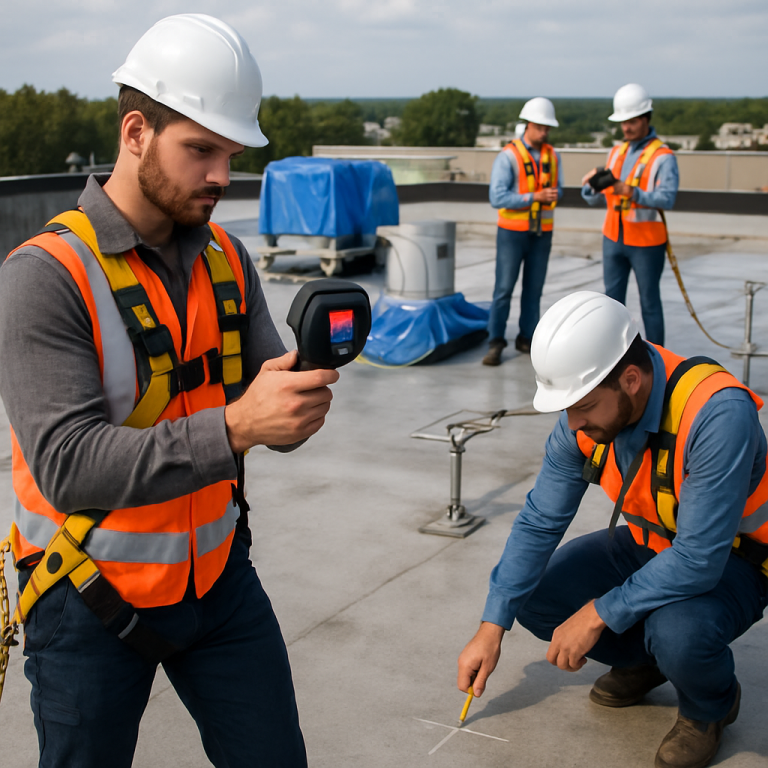
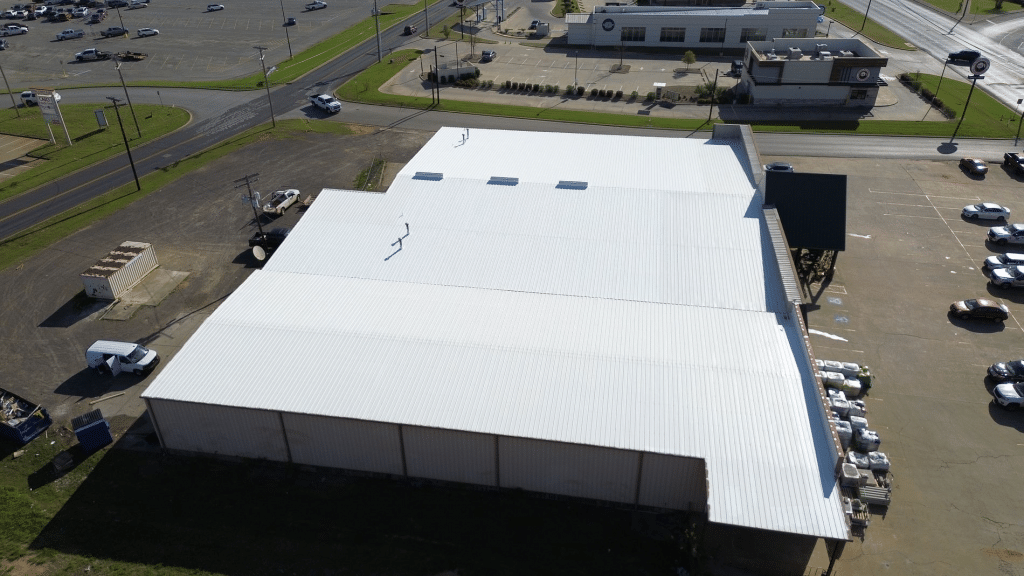
Concrete example: A mid-size distribution center with an aged TPO roof used targeted seam repairs and a silicone roof coating to defer full replacement. Post-application thermal scans and routine moisture probes reduced emergency leak calls and allowed the owner to spread capital replacement over a multi-year plan while maintaining occupancy and operations.
Judgment call: when you see ponding, membrane buckling, or widespread seam failure, budget for replacement. When failures are limited and the deck is sound, coatings plus a monitored maintenance program typically deliver the best near-term ROI. Expect procurement to require documented adhesion tests and explicit warranty coordination between product manufacturers and installers.
Material innovations reshaping waterproofing chemistry
Hard fact: the most consequential change in roof waterproofing over the next decade will be chemistry-driven, not membrane-driven. New liquid-applied systems and hybrid coatings change what you can do on an existing roof — but they also change the failure modes, installation controls, and procurement checkpoints owners must enforce.
What the new chemistries bring — and what they demand
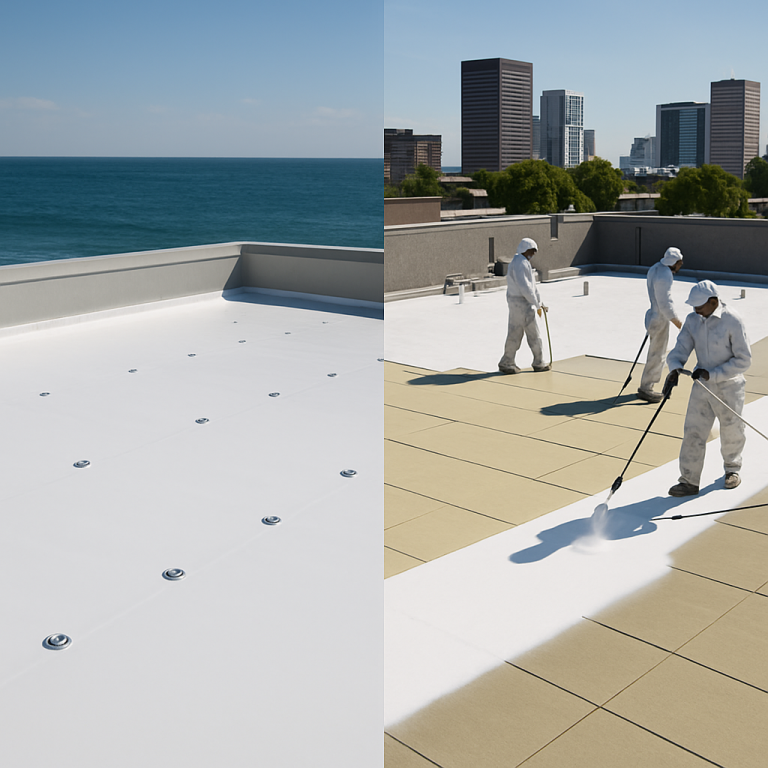
Material categories to watch: silicone coatings, polyurea and polyurethane hybrids, vapor-permeable liquid membranes, and nanotechnology-enhanced additives. Each solves a different field problem: silicones tolerate ponding and sunlight; polyurea gives rapid return-to-service and abrasion resistance; vapor-permeable liquids let trapped moisture escape without blistering.
Trade-off reality: rapid-cure products reduce downtime but amplify the cost of installation errors. Fast-set polyurea leaves little room for sloppy substrate prep; adhesion failures that would have shown slowly with older coatings appear quickly and catastrophically. Conversely, slower-curing silicone systems are forgiving on cure window but can complicate sequencing with rooftop trades and attract surface soiling that reduces reflectivity over time.
Testing and verification that actually matter: demand on-roof adhesion pulls, field mock-ups, and recorded cure-window conditions rather than brochure claims. Refer to performance frameworks from ASTM and follow NRCA guidance available at NRCA when you write specifications; manufacturer data must be backed by third-party test reports tied to the exact substrate and primer being used.
Concrete example: a municipal parking structure needed both traffic durability and ponding protection. The team applied spray polyurea to drive lanes and a seamless silicone overlay across flat slabs, with detailed transition flashing and adhesive-compatibility verification. The combined approach cut resurfacing downtime by 60 percent and reduced leak callbacks, but only because the contractor executed adhesion pulls, mock-ups, and a written transition detail that linked the two chemistries.
Emerging additives and limits: nanocoatings and hydrophobic treatments improve water-shedding and dirt resistance in lab tests, but field longevity is still limited to pilot programs. Be skeptical of claims that nano-additives eliminate cleaning cycles; in practice they slow soiling rather than stop it, and their incremental cost must show up in lifecycle modeling before scale-up.
Key procurement lever: require field mock-ups with adhesion pulls and recorded environmental conditions, and specify acceptable failure modes and repair paths in the contract.
Judgment for owners: adopt new chemistries selectively and with controls. Use them where they change the project economics — for example, to avoid disruptive full replacement or to add UV/ponding resistance to a structurally sound membrane — but insist on documented field performance, clear warranty coordination, and a monitored pilot before rolling them across a property portfolio. See our roof coating services for procedural templates at roof coatings.
Smart monitoring and predictive maintenance for waterproofing
Reality check: continuous sensing and scheduled analytics change roof waterproofing from episodic firefighting into measurable risk management. When sensors, aerial thermography, and asset platforms are used together, owners stop chasing visible leaks and start treating the roof as a performance system with measurable failure precursors.
What works in practice
Effective stack: combine targeted moisture or impedance sensors, routine drone thermography, and a lightweight asset management layer that ties sensor alerts to work orders in CMMS or facilities platforms. Sensors catch slow, hidden moisture intrusion; drones find thermal anomalies over large areas; the platform converts both into prioritized tasks with response SLAs.
Key trade-off: continuous monitoring reduces surprise failures but increases upfront cost and operational overhead. You pay for sensors, network infrastructure, and data handling — and for people or vendors to filter false positives. The trick is to deploy monitoring where the marginal value of preventing downtime exceeds the recurring cost — typically in facilities with sensitive interiors, high tenant disruption cost, or roofs with known vulnerability to ponding and seam stress.
- Practical deployment steps: validate membrane compatibility and get manufacturer sign-off on any penetrative sensors before purchase.
- Pilot approach: equip a small portfolio sample with wireless nodes and quarterly drone flights for 9–12 months to establish baseline patterns and tune alarm thresholds.
- Integration requirement: require the roofing contractor to supply a post-installation verification report that links sensor locations to building drawings and includes a test leak or moisture injection check.
Limitations to accept: many sensor systems report moisture presence without precise depth or cause. False positives from condensation, ponded water, or roof-access activities are common until the system learns site-specific patterns. Expect a learning curve and budget for 2–3 months of operational tuning after installation.
Concrete example: a three-building office campus installed wireless moisture nodes from Senseware and established quarterly drone thermography with high-resolution imagery from Nearmap. The monitoring program identified recurring ponding near a rooftop HVAC curb before interior damage occurred; the owner scheduled targeted seam repairs and a short-duration coating spot-application, avoiding an emergency replacement and a tenant disruption. The program paid for itself in avoided outage costs within two years on that roof segment.
Integration judgment: do not treat sensors as a warranty substitute. Many manufacturers will require non-penetrating installations or documented manufacturer approvals to keep warranties valid. Also, insist on data ownership and export capability in contracts so you can change analytics vendors without losing years of condition history.
Start small, validate signals, and tie alerts to an SLA — monitoring without an operational response plan simply creates noise.
Next consideration: draft procurement language that demands non-penetrating sensor options or manufacturer approvals, a pilot phase with measurable KPIs, and integration with your existing maintenance workflow. See our guidance on practical roof maintenance strategies at roof maintenance strategies and review vendor specifications such as Senseware or Onset HOBO when building a tech stack.