
When a leak appears or aging membranes start to fail, commercial building roof repair decisions get expensive fast. This guide delivers a practical, inspection-based framework with objective thresholds, diagnostic methods such as infrared moisture surveys and core sampling, and straightforward ROI comparisons to help you decide whether to patch, coat, or replace. You will walk away with measurable criteria, example cost models for typical roof sizes, and a contractor checklist to make a defensible, budget-aware choice that preserves waterproofing and asset value.
1. Roof Condition Assessment and Practical Inspection Checklist
Start with a measured assessment — not a gut call. A defensible decision to patch, coat, or replace begins with a systematic inspection that records three things: visible failure modes, diagnostic evidence of wet insulation or membrane detachment, and a quantified footprint for any problems you find. Skip the checklist and you turn every subsequent contractor recommendation into an opinion, not a decision.
Diagnostic tools and when to use them
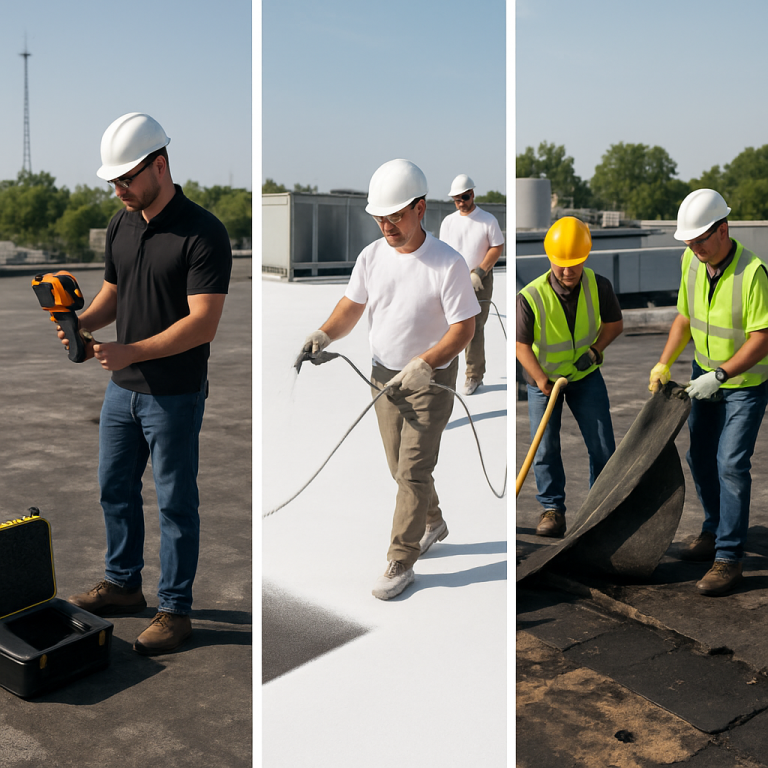
Choose the right diagnostic for the risk you need to resolve. Use an infrared moisture survey to screen wide areas quickly — but only when thermal differentials are sufficient and an experienced analyst interprets results. Use nuclear moisture meters or capacitance meters for spot confirmation, and always follow up suspect anomalies with core sampling; a core is the only non‑ambiguous proof of saturated insulation or deck failure. Lift testing is useful when adhesion of a membrane to substrate is in question.
Practical limits and trade-offs. Infrared is fast but yields false positives and negatives if scans are done at the wrong time of day or without calibration. Core samples are definitive but cost money (budget roughly $150–$500 per core depending on access and logistics) and leave small patched holes. Expect to combine methods: scan broadly, validate with meters, confirm with limited cores.
One‑page walkaround checklist (printable)
- Site header: date, inspector name, roof area (sq ft), weather and recent rainfall
- Safety/access: safe access points logged, fall protection used, roof load concerns noted
- Perimeter & flashings: check for separation, open terminations, rusted counterflashing
- Seams & penetrations: count visible seam failures, open welds, and compromised penetrations
- Drains & scuppers: note capacity, debris, and any ponding deeper than 1 inch after 48 hours of no rain
- Ponding observation: map locations and estimate square footage of ponding areas
- Membrane surface: blistering, abrasion, granule loss, or loose ballast documented with photos
- Skylights & rooftop equipment curbs: flashing condition and leak stains inside
- Interior signs: map ceiling stains, frequency of leak events, and active drip locations
- Measure and record: estimated percent of roof showing visible failure (round to nearest 5%), number of active leak locations
What to request from a paid contractor inspection
- Deliverables: written moisture survey with annotated roof plan, raw IR images, and analyst notes
- Confirmatory cores: location list for core samples and lab or field moisture results
- Adhesion data: lift test results where coating adhesion or membrane reattachment is proposed
- Area quantification: percent of roof with wet insulation or membrane detachment stated explicitly
- Repair scope matrix: line‑itemed options for patch, coat, or replace with unit prices and warranty implications
- Product references: exact manufacturer and product data sheets for any proposed coating or membrane
Concrete example: A 40,000 sq ft warehouse inspection found three flashing failures, two blocked drains causing localized ponding, and an infrared survey indicating about 8% wet insulation concentrated near the east edge. The contractor recommended targeted removal and replacement of saturated boards plus a silicone coating over the repaired areas — a defensible coat strategy only after removing identified wet insulation and repairing drains, otherwise coating would likely fail within a few years.
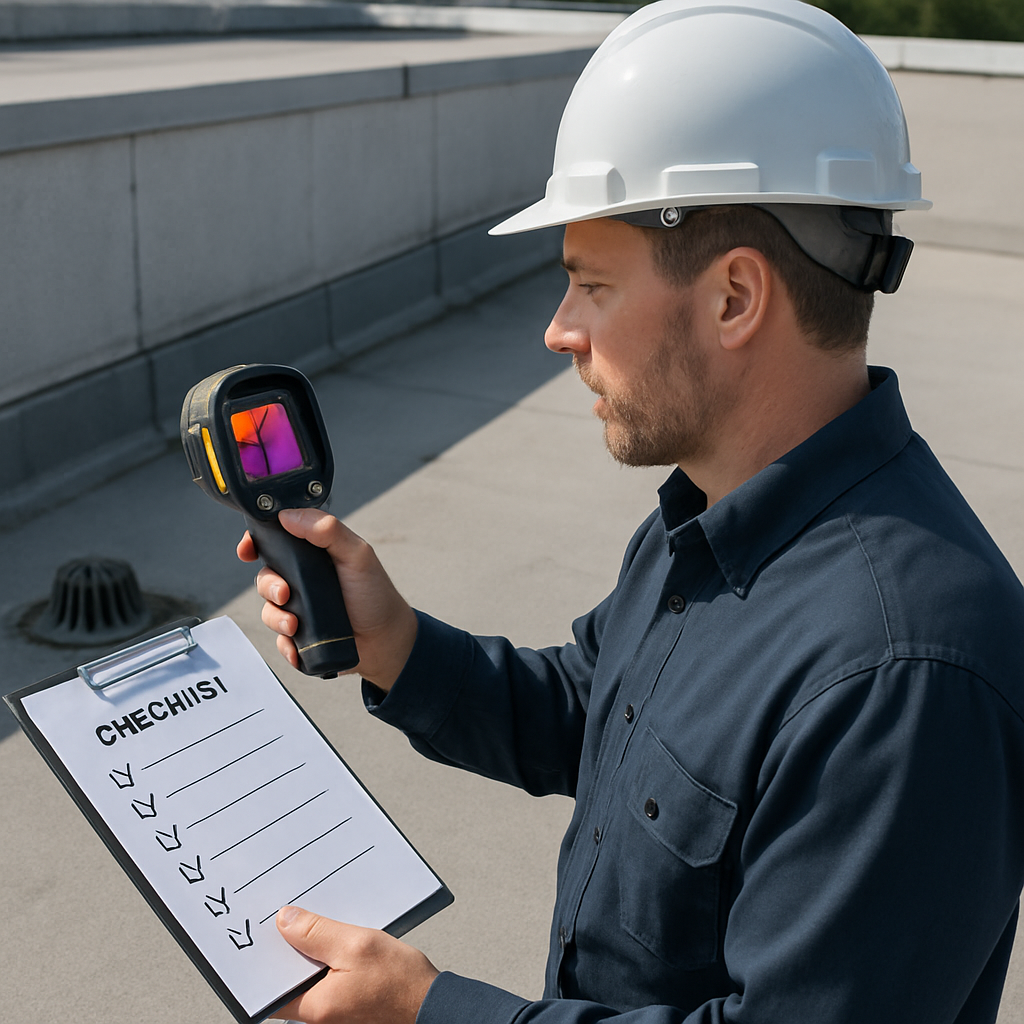
Next consideration: If your initial walkaround raises more than one of the red flags in the info box, commission a moisture survey and a small set of core samples before accepting any coating estimate. For an inspection or to request a moisture‑based assessment, use contact or review methodology references at NRCA.
Frequently Asked Questions
Quick orientation: For commercial building roof repair decisions, the single most useful evidence is documented moisture and adhesion data — not a contractor opinion. Demand that diagnostic deliverables accompany every recommendation so you can compare patch, coat, or replace on the same facts.
How dependable are infrared scans and when are cores mandatory? Infrared surveys are an efficient screening tool but they are conditional: scans need proper thermal contrast, experienced interpretation, and corroboration. If an IR scan highlights anomalies covering more than a few percent of the roof, insist on targeted core samples and reportable moisture readings before approving a coating. Cores are the non‑negotiable proof that will either validate a coating plan or force a replacement budget.
Can coatings fix drainage or structural issues? No. Coatings address the membrane surface, not roof geometry or structural deck problems. Applying a silicone or acrylic coating over persistent ponding, failing flashings, or a delaminated deck is a high‑risk, short‑lived gamble. Tradeoff: coatings can extend life cheaply when substrates are dry and drains corrected, but they become a sunk cost when underlying problems remain.
Warranties and maintenance — what traps owners miss? Warranties often require certified installers, documented prework diagnostics, and scheduled maintenance. If the contractor skips moisture documentation or surface prep, the manufacturer can deny claims later. From a practical standpoint, treat warranty acceptance as a checklist item when comparing bids: if the installer cannot show pre‑approval paperwork, price that risk into your ROI calculation.
How should I evaluate contractor proposals for a coating versus a replacement? Require line‑item costs for diagnostics, repairs (including saturated board replacement), coatings or membranes, and separate mobilization/traffic control charges. Ask for explicit recoat windows and how they will handle rooftop equipment removal or penetrations. Meaningful judgment: cheapest per‑square‑foot coatings quotes usually omit critical prep work that causes premature failure.
Season and timing matter. Coating chemistry and adhesion are temperature and humidity sensitive. Scheduling work in the wrong season can force rushed surface prep or extended cure times that jeopardize warranties. For projects that must avoid disruption, plan coatings or replacements in the optimal weather window and include contingency days in the schedule.
Integration questions: solar, green roofs, and metal work. If you intend to add rooftop solar or a green roof, factor those plans into the repair decision now. A coating may complicate future panel anchoring or warranty transfers; a full replacement offers a clean substrate for installations and often simplifies long‑term waterproofing. Coordinate with your solar vendor and include their requirements in the roofing scope.
Concrete example: A 12,000 sq ft retail roof received a low‑cost acrylic coating without cores. Within 18 months, blistering and leaks returned across a 20% area. Post‑failure testing showed saturated insulation under the failed sections; the building ultimately required a partial tear‑off and replacement that cost more than twice the original coating plus repairs. That outcome was preventable with two cores up front.
Next concrete steps: 1) Commission a moisture survey and insist on deliverable scans and core reports; 2) Collect three competing bids that include diagnostic documentation and warranty paperwork; 3) Add a maintenance and inspection clause to the contract to preserve warranty coverage; 4) If you need help drafting diagnostic requirements or an RFP, use contact to request a moisture‑based assessment or review our coating criteria at roof coatings.